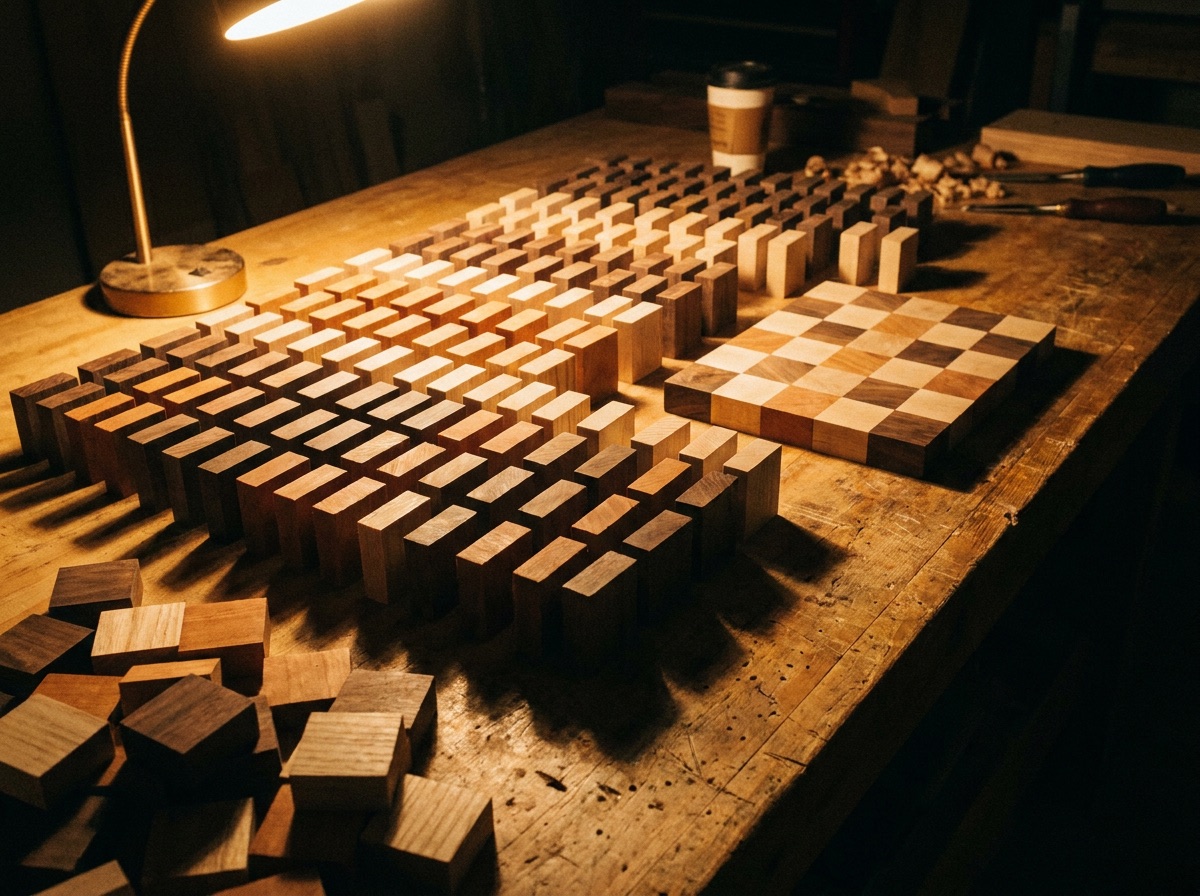
One bench. No batches.
A workshop in eastern Slovakia, a rack of air-drying timber, and one board on the bench at a time. Output is deliberately capped: a board that is hurried is a board that cups, splits or opens at a joint two years later, and there is no way to hurry a glue-up or a cure.
Everything you can see here is done by hand.
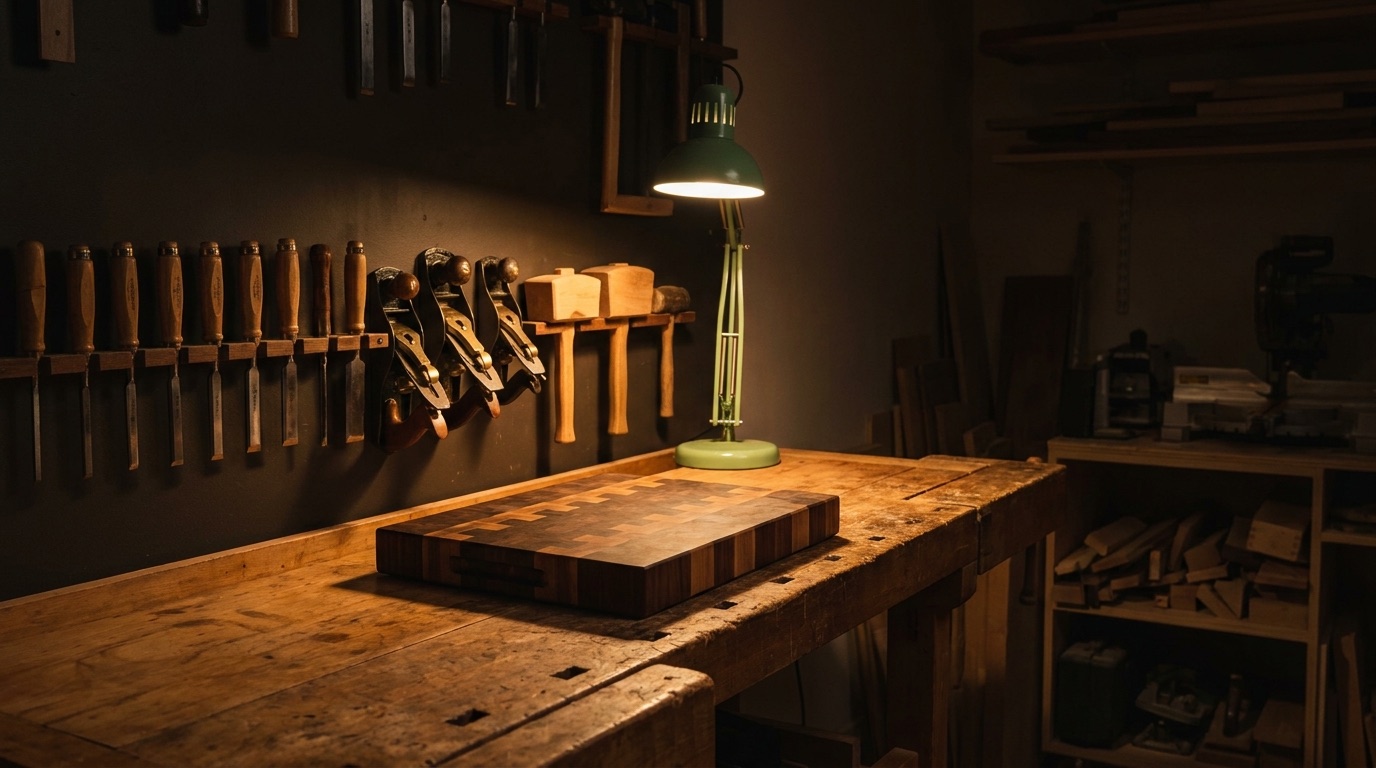
A board built for one kitchen, then forty more.
Noir Grain began in 2016 with a single board built as a wedding present, and a chef who saw it, asked who made it, and ordered four for the pass. There was no plan beyond that. The workshop grew one commission at a time.
Ten years later the method has barely changed. We still buy timber as whole boules rather than pre-dimensioned stock, because a boule tells you what the tree actually was: where it leaned, where it healed, where the colour runs. We still air-dry for a year in the yard before anything is cut. And we still put a straight edge across every finished board before it goes in the box.
What has changed is that the boards now go to Copenhagen, Kyoto and Chicago as often as they go to the next village. Nothing is sold through a shop; every board leaves this bench for the address that ordered it.
Sixteen days a board, and nine of them are waiting.
Before any of it starts, the timber has already spent a year in the yard. Nothing below can be compressed: glue needs the night, oil needs the day between coats, and a block that is machined before it has finished moving will move again in your kitchen.
-
Step one
The boule
Whole trees, bought from Slovak mills, stacked and stickered in the yard for twelve months until they reach eight per cent moisture. Nothing is cut before then, and no kiln shortens it.
-
Step two
The blanks
Boards are ripped to width, glued into a striped panel, then crosscut into slices and turned ninety degrees. That turn is the whole trick: the fibres now point up.
-
Step three
The glue-up
Blanks are laid out by eye into the scallop or the tumbling block, then clamped with D4 waterproof adhesive and left overnight. One board, one clamp rack, no batching.
-
Step four
The finish
Flattened, bordered in mitred walnut, chamfered, then sanded up through five grits to 320. End grain resists every one of them. Three coats of mineral oil over four days, and a beeswax balm buffed in by hand.
Four species. No stains, no dyes.
Every colour you see in a Noir Grain board is the wood itself. Janka figures are the industry hardness measure: anything above 1,000 lbf holds up to daily knife work.
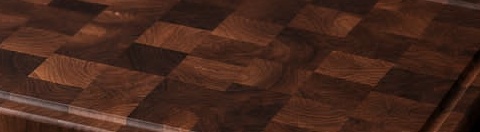
Black walnut
Juglans nigra · 1,010 lbf
The dark tone in every board, and the only species we use for borders. Chocolate brown with a purple cast that deepens for the first two years, then holds.
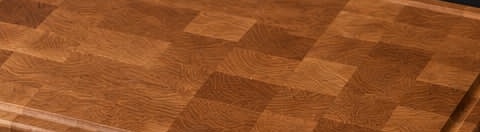
European oak
Quercus robur · 1,120 lbf
Light to mid brown, and the most openly grained of the four: on the end you can read every growth ring. Hard, dense and the most forgiving of daily use.
European cherry
Prunus avium · 995 lbf
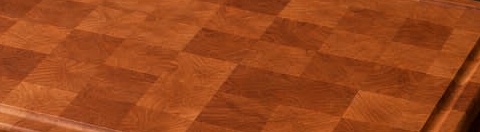
The warm red-amber. Cherry darkens faster than anything else in the rack: a board photographed on day one looks noticeably richer by the following summer.
Hard maple
Acer saccharum · 1,450 lbf
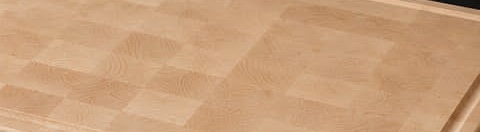
The pale, almost white tone that makes the pattern read, and the hardest wood in the rack. Tight-pored, close to non-absorbent, and the standard for commercial butcher blocks for good reason.
There is no shop.
Boards are sold here and nowhere else: no showroom, no stockists, no resellers. Nothing sits in a warehouse waiting for a buyer, which is why the wait is three to four weeks and why the board that arrives was cut after you ordered it.
If you want to see one before you commit, write and ask. We will send photographs of the actual boards on the bench that week, in whatever species you are considering.
Ask a question| Founded | 2016 |
|---|---|
| Workshop | Eastern Slovakia, European Union |
| Timber | Sourced in Slovakia, air-dried 12 months |
| Build time | 16 working days a board |
| Sold | Online only, built to order |
| Guarantee | 10 years, structural |